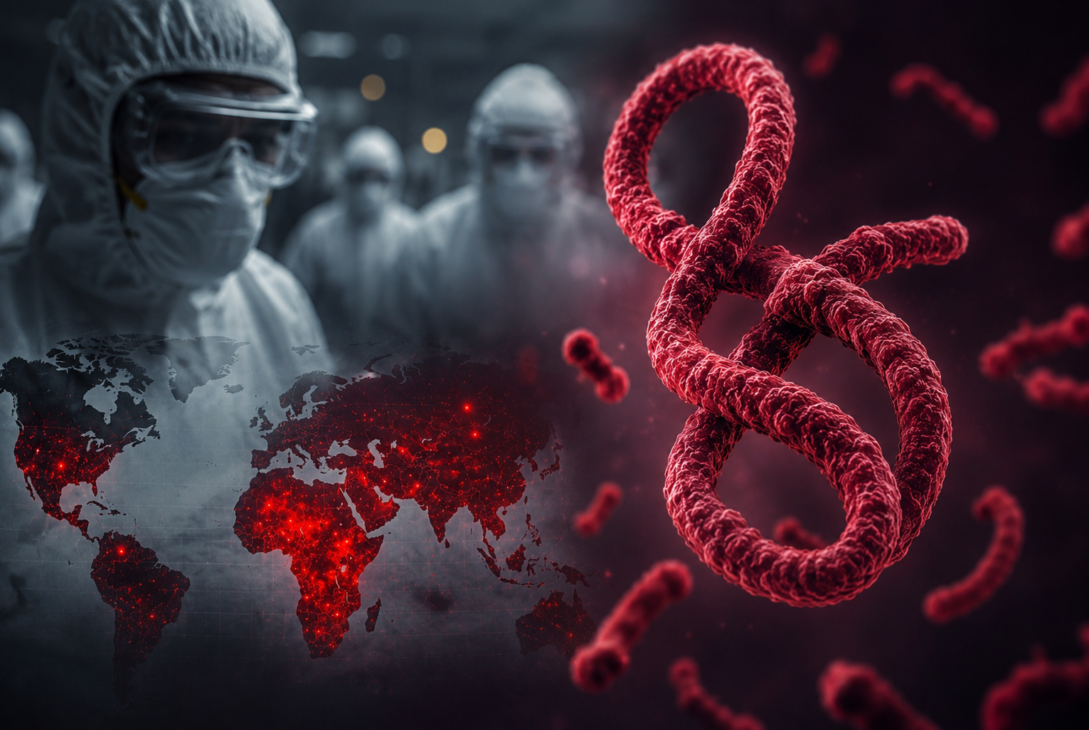
A bad disease is spreading in Africa right now. The Ebola disease has broken out again in the Democratic Republic of Congo. It has already crossed the border into Uganda. Lots of people have died from the Ebola disease. Many people are suspected of having Ebola disease. Health workers all around the world are trying really hard to stop the Ebola disease before it spreads even more. This is not a drill.
The World Health Organization stated that obesity is a problem affecting everyone’s health worldwide on May 17, 2026. The World Health Organization does not issue warnings like this often, so when it does, we must pay attention to what it is saying.
So What Exactly Is Ebola?
Ebola is a virus that affects the body quickly. It hits the body hard and fast. The early symptoms of Ebola are similar to those of the flu, including fever, body aches, and a rash. However, Ebola can get much worse if not treated. The Ebola virus attacks the body in a way. Early signs of Ebola are similar to those of the flu. People with Ebola may have a fever, body aches, and a rash. The disease can progress rapidly.
- Ebola is an illness that causes symptoms.
- The body gets affected quickly by Ebola.
- The symptoms start with a fever.
- Then came body aches and a rash.
Ebola can become very serious. The virus damages organs. It causes internal bleeding. Without the right care, it kills.
The Ebola disease is something that can spread when you come into contact with body fluids like blood, sweat, and saliva from someone who already has the Ebola disease.
If you touch someone who has died from Ebola disease, you can get the Ebola virus too.
Ebola disease is very hard to stop from spreading in communities where people take care of their family members at home, and this is one reason why the Ebola disease spreads so quickly in these communities, because people are touching the Ebola disease when they are taking care of their family members who have the Ebola disease.
Ebola is not new. It was first discovered near the Ebola River in the DRC back in 1976. This current outbreak is the 17th time the DRC has had to deal with it. Seventeen times. That says a lot about how difficult the situation in that country has been for decades.
The Bundibugyo Strain — The Scary Part
Here’s what makes this outbreak different from some of the past ones. The Ebola spreading right now is caused by something called the Bundibugyo strain. It’s a rarer type. And here’s the thing that really worries health officials — there is no approved vaccine for it. No specific treatment either.
With past Ebola outbreaks, doctors at least had some tools. Not this time. Doctors Without Borders, also called MSF, says the Bundibugyo strain is very bad. It kills a lot of people. For every 100 people who get the Bundibugyo strain, 25 to 40 of them will die. This is a problem. The Bundibugyo strain kills a lot of people even when they get help from Doctors Without Borders, also known as MSF.
What the Numbers Look Like Right Now
As of May 17, the Democratic Republic of Congo had a problem in the Ituri province. This province is in a part of the country, and it is really far away from everything. At least 80 people probably died and 246 more probably got sick in the Ituri province of the Democratic Republic of Congo.
Eight of those cases were confirmed through lab tests.
Uganda has reported two lab-confirmed cases in its capital city, Kampala. One of those people has already died.
Among the dead in the DRC are four healthcare workers. Nurses and doctors. People who showed up to help others and paid for it with their lives. That tells you how dangerous conditions are on the ground right now — even people wearing protective gear are getting sick.
Why Uganda’s Cases Are a Red Flag
Two cases in Kampala might not sound like a lot. But here’s the problem — those two people had no connection to each other. They didn’t know each other. They didn’t live in the same area or work at the same place.
When that happens, experts start to worry. This usually means the disease has been spreading quietly, in places and among people that haven’t been detected yet. Professor Adrian Esterman from Adelaide University said it clearly — unconnected cases showing up in a new city are often a warning sign that the outbreak in the DRC is far bigger than what authorities can currently see.
What Is Being Done
The response has been really fast. The situation is very tough. The World Health Organization sent seven metric tons of emergency supplies to Bunia, the main city in the Ituri province. Things like protective suits, gloves, tents, and hospital beds.
A team of 35 experts arrived from Kinshasa, the capital of the Democratic Republic of Congo, to support the frontline workers at the hospital and other places. The World Health Organization is doing a lot to help the people in the Ituri province.
Doctors Without Borders is getting ready to launch a large operation in the region as quickly as possible.
The US Centers for Disease Control and Prevention — the CDC — is also involved. They’re helping with contact tracing, lab testing, and tracking how the disease is moving. They’re also trying to relocate a small number of American citizens in the DRC who were directly exposed to the virus.
Both the DRC and Uganda have put screening measures at airports. Anyone trying to board a flight out of those countries is being checked for signs of illness.
Why This Is So Hard to Fight
The DRC’s eastern provinces have conflicted for years. Armed groups have been fighting there for a long time. Millions of people have been forced to leave their homes. Roads are unsafe. Hospitals don’t have enough supplies. Health workers can’t always get to where sick people are.
- Trying to stop a disease outbreak in a war zone is really tough.
- The infrastructure just isn’t there to support it.
- This is one reason the outbreak has spread so quickly.
- The war zone lacks facilities to tackle the disease.
- Outbreaks grow fast in areas.
- The infrastructure issue is a problem.
- The Bigger Problem Nobody Wants to Talk About
This outbreak is happening at a terrible time for global health funding. The WHO is broke — or close to it. The United States used to pay for almost one-fifth of the WHO’s entire budget. Then, earlier this year, the US officially pulled out of the organization. The result? The WHO had to cut its budget by about 9 percent for 2026 and 2027. Programs got gutted. Pandemic preparedness took a hit.
Health experts have been warning about this. Krutika Kuppalli, who is a doctor who deals with diseases in Dallas and has experience with outbreaks all around the world, said it in a simple way. If we cut the money that the World Health Organization gets it will take longer to find out about outbreaks, it will take longer to respond to them, and it will be harder to stop bad diseases from spreading everywhere.
That’s not all. Many people in lots of countries are starting to question vaccines. More people than ever are saying no to vaccines. Waiting to get them. If a vaccine for the Bundibugyo strain were made today, it would be hard to get it to the people who need it and to convince them to take it. This would be a challenge.
The Bottom Line
Ebola has been beaten back before. It can be done again. But it takes speed, resources, honest communication, and countries working together — not pulling in different directions.
What’s happening in the DRC right now is a test. The patients there are real people. The health workers risking their lives are real people. And the decisions made in the next few weeks — about funding, about vaccines, about global cooperation — will matter far beyond Africa.
The world has been through this before. The question is whether it has learned enough from those times to do better now.