
Personal wellness is the everyday practice of looking after your whole self, not just your body. It covers how you move, sleep, eat, think, feel and connect with other people.
If you want to feel better but have no idea where to start, you are not alone. Wellness advice is everywhere, and most of it tells you to change everything at once. That is a fast way to feel overwhelmed and quit by Friday.
Here is the good news: wellness is personal. What works for a night-shift nurse will not look like what works for a college professor or a new parent. Your plan only has to fit your life.
In this guide, you will learn:
- what personal wellness means, and how it differs from health and fitness
- the six dimensions of wellness, with one easy example for each
- how to check in with yourself in about ten minutes
- how to build a personal wellness plan in five steps
- daily habits that support your plan, and mistakes to avoid
Take it one section at a time. Small, steady steps beat big, short-lived ones.
What Is Personal Wellness?
Personal wellness is the ongoing process of making choices that help you live a healthy, balanced and meaningful life. It is not a finish line. You do not “get” wellness and then stop.
Two ideas sit at the heart of it:
- It is active. Wellness comes from the small choices you make each day.
- It is personal. Your body, budget, culture, schedule and stage of life are different from anyone else’s, so your plan should be too.
Wellness also looks beyond the body. The World Health Organization’s constitution defines health as complete physical, mental and social well-being, not just the absence of WHO Constitution. Wellness builds on that wider view.
Wellness vs. health vs. fitness. People use these words as if they mean the same thing. They overlap, but they are not identical.
| Wellness | Health | Fitness | |
| Focus | Choices and habits across your whole life | Your physical, mental and social well-being, including any medical conditions | How well your body handles physical effort |
| Nature | An ongoing process | A state that changes over time | An ability you can build |
| Everyday example | Keeping a regular bedtime, calling a friend, walking after lunch | Having energy, steady mood and a managed medical condition | Climbing stairs without getting winded |
| Who tracks it | You, by how you feel and function | You and your healthcare professional | You, a trainer, or simple tests |
These are plain-language working definitions, and experts word them in different ways. For a deeper comparison, see our guide to [LINK: wellness vs fitness vs health post].
Why it matters. Thinking in terms of wellness helps you notice the parts of life that usually get skipped, such as rest, stress and relationships. Health agencies take these seriously. The CDC says long-term stress can lead to worsening health problems CDC – Managing Stress, and that social connection can help reduce the risk of chronic disease and serious illness CDC – Social Connection.
You do not need to fix everything. You only need to know where you are and take the next small step.
The Dimensions of Personal Wellness
Many frameworks split wellness into dimensions, which are different areas of life that all affect how you feel. SAMHSA, a US health agency, lists eight: emotional, environmental, financial, intellectual, occupational, physical, social and spiritual SAMHSA – Eight Dimensions of Wellness.
This guide uses six that most people find easy to start with. They overlap, so a walk with a friend counts as both physical and social. For the full picture, see our post on the [LINK: dimensions of wellness post].
Physical Wellness
Physical wellness is about caring for your body through movement, food, sleep and routine health care. It is not about how you look.
Try this: Take a 10-minute walk after lunch three days a week. The CDC says adults need at least 150 minutes of moderate-intensity activity a week, and that you can spread it out in smaller chunks CDC Physical Activity Guidelines.
Mental Wellness
Mental wellness is how you think, learn, focus and manage the daily load in your head. It includes giving your mind a real break.
Try this: Do a five-minute “brain dump” each evening. Write down tasks and worries on paper so they are not circling in your head at bedtime.
Emotional Wellness
Emotional wellness is about noticing and handling your feelings. NIH describes it as being able to cope with life’s stresses and adjust to change and hard times NIH Emotional Wellness Checklist. It does not mean feeling happy all the time.
Try this: At the end of the day, write down one thing you got done. NIH suggests focusing on what you accomplished, not on what you missed NIH Emotional Wellness Checklist.
Emotional wellness matters at every life stage. New parents in particular can struggle, and our article on the consequences of ignoring maternal mental health looks at the topic in more depth.
Social Wellness
Social wellness is a sense of belonging and having people you can lean on. The CDC says staying connected to others helps people feel that they belong and are valued CDC Social Connection Guide.
Try this: Book one phone call or coffee with a friend each week, and put it in your calendar like any other appointment.
Intellectual Wellness
Intellectual wellness is about staying curious and using your mind in creative ways. SAMHSA ties it to using your creative abilities and finding ways to grow your knowledge and skills SAMHSA – Eight Dimensions of Wellness.
Try this: Read ten pages of a book, or learn one new word, recipe or skill, each day.
How to Assess Your Personal Wellness
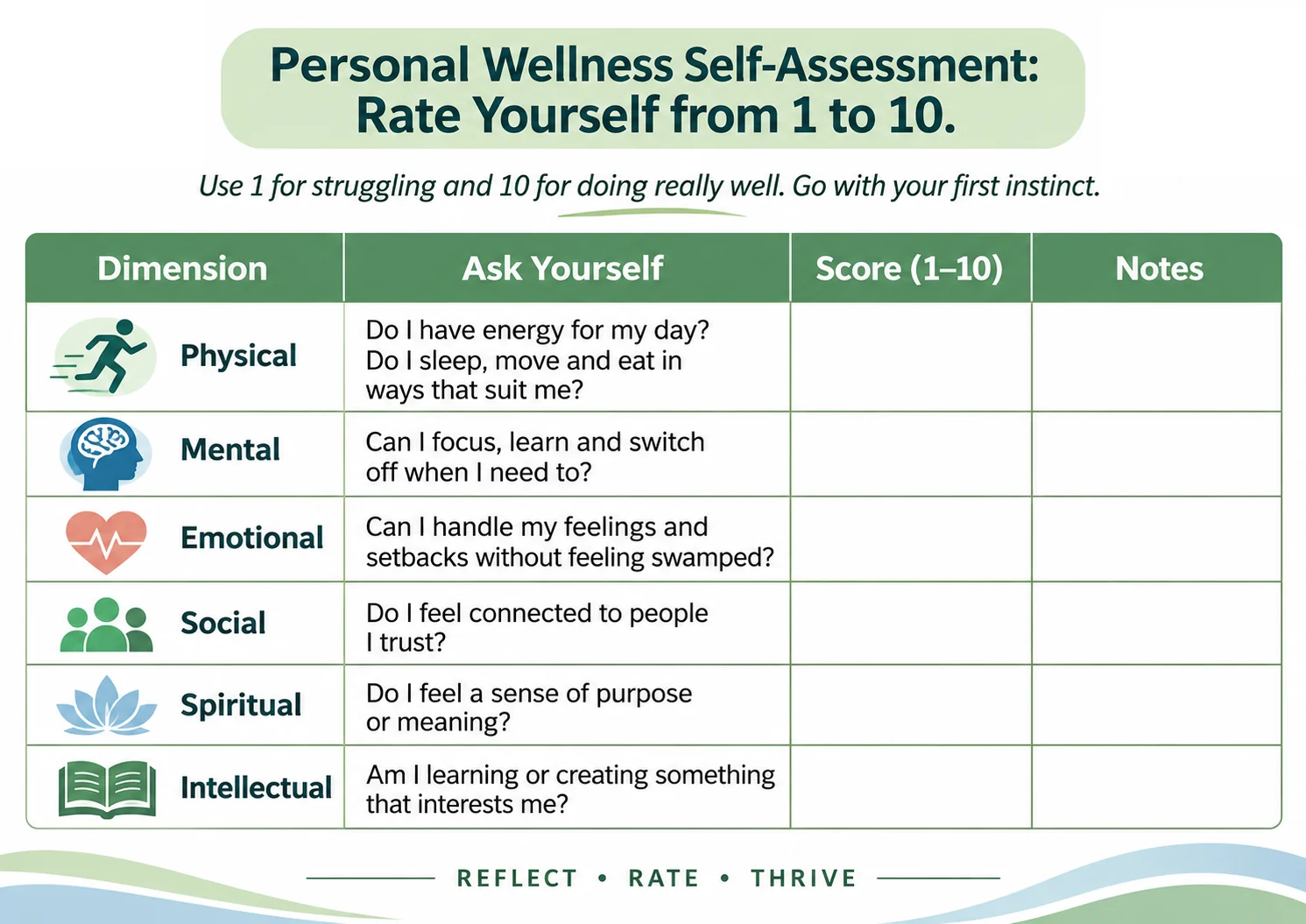
Before you change anything, take a quick look at where you are now. This takes about ten minutes. Grab a pen and answer the questions below honestly. There are no right answers.
Self-reflection questions
- Do I wake up feeling reasonably rested on most days?
- Do I move my body in ways I enjoy, even for a few minutes a day?
- When I feel stressed, what do I usually do, and does it actually help?
- Is there at least one person I can talk to honestly?
- Do I make time for something that is just for me?
- Do I feel curious and engaged, or stuck on autopilot?
- Do my days connect to what I care about?
- Which area of my life gets the least attention right now?
Rate yourself from 1 to 10
Use 1 for “struggling” and 10 for “doing really well.” Go with your first instinct.
| Dimension | Ask yourself | Score (1-10) | Notes |
| Physical | Do I have energy for my day? Do I sleep, move and eat in ways that suit me? | ||
| Mental | Can I focus, learn and switch off when I need to? | ||
| Emotional | Can I handle my feelings and setbacks without feeling swamped? | ||
| Social | Do I feel connected to people I trust? | ||
| Spiritual | Do I feel a sense of purpose or meaning? | ||
| Intellectual | Am I learning or creating something that interests me? |
How to read your scores. Look for the one or two lowest numbers. These are your starting points. Also note your highest score, because that is something you can lean on.
This is a self-reflection tool, not a medical test or a diagnosis. If you feel low, anxious or unable to cope for more than a short time, read the section on when to talk to a healthcare professional below.
How to Create a Personal Wellness Plan
A personal wellness plan is a short, written list of what you want to improve and the small daily actions that will get you there. It should fit on one page. If you would like a ready-made layout, see our [LINK: personal wellness plan template].
Follow these five steps.
Step 1: Assess your current state. Use the rating table above. Pick your one or two lowest areas, and one area that is going well. You will work on the first and protect the second.
Step 2: Set 2-3 realistic goals. More than three goals at once is usually too many. Make each wellness goal specific and small enough that you can picture doing it this week.
| Too vague | Realistic and specific |
| Get healthier | Walk for 10 minutes after lunch, three days a week |
| Manage stress better | Take five slow breaths before checking email each morning |
| Be more social | Call one friend every Sunday evening |
| Sleep better | Switch off screens 30 minutes before my usual bedtime |
Need more ideas? Browse our list of [LINK: wellness goals examples].
Step 3: Pick small daily habits. For each goal, choose one habit so small you could do it on your worst day. Then tie it to something you already do, such as “After I brush my teeth, I drink a glass of water.” A habit that is easy to start is easier to keep.
Step 4: Fit them into your routine. Look at your real week, not your ideal one. Choose a time and place for each habit, and plan for the usual obstacles. For example: “If it rains, I will stretch at home instead of walking.” Include time for self care, too. It is part of the plan, not a reward you earn. Our guide to a [LINK: daily wellness routine] shows how to build the pieces into a day, and our [LINK: self-care ideas] post has easy options.
Step 5: Track and review. Keep it simple. Put a tick on a paper calendar each time you do a habit. Once a week, spend five minutes asking:
- What worked?
- What got in the way?
- What one thing will I change next week?
Once a month, score yourself in the table again. Missing a day is normal. Just restart the next day.
A sample one-page plan
| Goal | Daily habit | When and where | Check |
| Move more | 10-minute walk | After lunch, around the block | Tick on calendar |
| Feel less rushed | 5 minutes of quiet with no phone | Before work, at the kitchen table | Tick on calendar |
| Stay connected | Send one message to a friend or family member | During the evening commute or after dinner | Weekly review |
Daily Habits That Support Personal Wellness

You do not need a dozen habits. Start with the ones below that match your lowest scores, and add more later.
Sleep. The CDC says adults need at least 7 hours of sleep a day CDC – Sleep in Adults. Going to bed and waking up at the same time each day can help you sleep better CDC – Managing Stress. If sleep is your weak spot, our post on [LINK: sleep and wellness] goes deeper.
Movement. The CDC recommends at least 150 minutes of moderate-intensity activity a week, plus muscle-strengthening activity on 2 or more days. You can break it into smaller chunks, and some activity is better than none CDC – Adult Physical Activity Guidelines. Prefer something gentle? Our guide to building a yoga habit is a good place to start, and you can read more in [LINK: yoga for wellness].
Research on yoga for stress is mixed: some studies show benefits and some do not NCCIH – Stress
Nutrition. The CDC describes healthy eating as focusing on whole, nutrient-dense foods such as vegetables, fruits, protein foods and whole grains, and says eating patterns can reflect your preferences and budget CDC – Healthy Eating Tips. Our list of the top 25 heart-healthy foods gives you plenty of ideas. If you like quick breakfasts, these smoothie ideas for healthy habits are one way to add more fruit to your day. For digestion, see [LINK: gut health and wellness].
Hydration. There is no single right amount for everyone. Mayo Clinic says needs depend on your health, age, activity level, where you live and the weather. You may be drinking enough if you rarely feel thirsty and your urine is colorless or light yellow. Tea, coffee and milk count toward your fluids, and food provides about 20% of what you need Mayo Clinic Hydration Guide.
Stress breaks. The CDC suggests taking breaks from news and social media, taking deep breaths, stretching, journaling and spending time outdoors CDC – Managing Stress. NIH says a 30-minute walk a day can boost mood and reduce stress NIH – Emotional Wellness Checklist . For more options, see [LINK: stress management techniques].
Social connection. The CDC suggests talking with people you trust about your concerns and how you are feeling CDC – Managing Stress. A short message or a five-minute call counts.
Common Mistakes to Avoid
Most wellness plans fail for simple reasons. Watch out for these:
- Doing too much, too soon. Start with two or three goals. You can always add more.
- Copying someone else’s routine. A plan that works for a friend may not suit your schedule, body or budget.
- Treating wellness as weight loss. Weight is only one small part of the picture. If it is one of your goals, our guide to losing weight naturally and staying healthy covers gentle habits.
- Aiming for perfect. Missing a day does not undo your progress. Restart the next day.
- Skipping rest and fun. Rest and enjoyment are part of wellness, not extras.
- Never reviewing your plan. Your life changes, so your plan should too. Check in weekly and rescore monthly.
- Trusting random online advice. Check health claims against trusted sources, such as the CDC, NIH or your healthcare professional.
When to Talk to a Healthcare Professional
This guide is for general information. It cannot replace advice from someone who knows your medical history.
Talk to a doctor or other qualified professional if:
- you have a medical condition, are pregnant, or take regular medication, and you plan to make big changes to your exercise or eating
- a symptom is new, severe or does not go away
- you are unsure how much water is right for you. Mayo Clinic says a healthcare professional can help you find the amount that suits you Mayo Clinic Hydration Guide
- you feel unable to cope, or you are using drugs or alcohol to cope. NIH advises talking to a mental health professional in these cases NIH Emotional Wellness Checklist
If you are in crisis or thinking about harming yourself, get help right away. In the US, you can call or text 988 CDC – Managing Stress. If you are outside the US, contact your local emergency number or crisis service. [ADD: local helpline details for your main readership]
FAQs
What is personal wellness?
Personal wellness is the ongoing process of making choices that support a healthy, balanced and meaningful life. It covers more than physical health. It also includes your mind, emotions, relationships and sense of purpose.
What are the dimensions of wellness?
SAMHSA, a US health agency, lists eight dimensions: emotional, environmental, financial, intellectual, occupational, physical, social and spiritual SAMHSA – Eight Dimensions of Wellness. This guide focuses on six common ones: physical, mental, emotional, social, spiritual and intellectual.
How do I create a personal wellness plan?
First, assess where you are now. Then set two or three realistic goals, choose one small daily habit for each, fit the habits into your routine, and review your progress once a week.
What is a daily wellness routine?
A daily wellness routine is a short set of habits you repeat most days. Examples include getting up at a regular time, moving your body, drinking fluids, taking a short stress break and staying in touch with people you trust. Keep it small enough to do on a busy day.
What are some examples of wellness goals?
Good wellness goals are small and specific. For example: walk for 10 minutes after lunch three days a week, go to bed at the same time on weeknights, call a friend every Sunday, or have a glass of water with each meal.
What is the difference between self care and wellness?
Self care is the set of small actions you take to look after yourself, such as resting, spending time outdoors or talking to a friend. Wellness is the bigger picture: how those actions and your other habits support your whole life.
Conclusion
Personal wellness is not about perfect routines or big overhauls. It is about knowing where you stand, choosing a few small goals, and showing up for them most days.
Start today. Do the 1 to 10 check-in, pick one habit, and put it in your calendar. In a month, look back and see what changed.
Ready for the next step? Explore the [LINK: dimensions of wellness post] for a closer look at each area, or join our newsletter for simple, practical wellness tips in your inbox. [LINK: newsletter signup page]
Disclaimer: This article is for general education only. It is not medical advice and does not diagnose, treat or prevent any condition. Always talk to a qualified healthcare professional before changing your diet, exercise or medication, or if you have concerns about your health.