
Finding breast cancer early can change everything about treatment and survival. But small tumours are not always easy to spot, especially in women with dense breast tissue. A new experimental blood test may one day help.
A study published in Nature on 11 November 2026 describes the test, which was developed by researchers at the Weizmann Institute of Science and the Hebrew University of Jerusalem in Israel. It looks for chemical changes in tiny DNA-containing structures that float in the blood. The team reported an area under the curve (AUC) of 0.95 for telling breast cancer samples from healthy ones, including early-stage disease. They also found markers that may point to a higher risk of the cancer coming back.
The results are encouraging. Still, the test is experimental, and it is a long way from routine screening.
For more details, read the original Nature research paper on the experimental breast cancer blood test.
What Is the New Breast Cancer Blood Test?
The test comes from an international team led by Prof. Efrat Shema at the Weizmann Institute and Prof. Guy Ron at the Hebrew University.
Mammograms and biopsies look at the breast tissue itself. This test works differently. It searches the blood for molecular clues. The researchers first studied how breast cancer cells differ chemically from healthy cells. Then they built a way to look for similar patterns in blood samples.
The method is called EPINUC, short for epigenetics of plasma-isolated nucleosomes. It examines tiny structures called nucleosomes that circulate in the bloodstream.
The Times of Israel’s report on the Israeli breast cancer blood test also explains the research and its potential importance for early cancer detection.
How Can a Blood Test Detect Breast Cancer?
When cells die or break down, they release small amounts of their contents into the blood. That includes DNA and proteins, which carry information about the cells they came from. Cancer cells do the same, so these fragments can hold early clues that something is wrong.
The new test focuses on two things: epigenetic changes and nucleosomes.
What Are Epigenetic Changes?
Your DNA holds the instructions for how cells grow, work and repair themselves. But not every gene is active at the same time. Chemical tags act like switches, turning genes on or off. These tags are called epigenetic changes. They don’t alter the DNA code. They only change how the cell reads it.
In cancer, the pattern of tags can shift. Some shifts let cells grow faster, ignore normal controls or behave more aggressively. The researchers found that certain breast cancer cells carried distinct patterns linked to more aggressive disease. Patterns like these could help flag cancer and give hints about how it may behave.
Why Are Nucleosomes Important?
Nucleosomes are tiny structures in which DNA is wrapped around proteins called histones, a bit like thread on a spool. When cells break down, nucleosomes can end up in the blood, still carrying the chemical tags from the cell they came from.
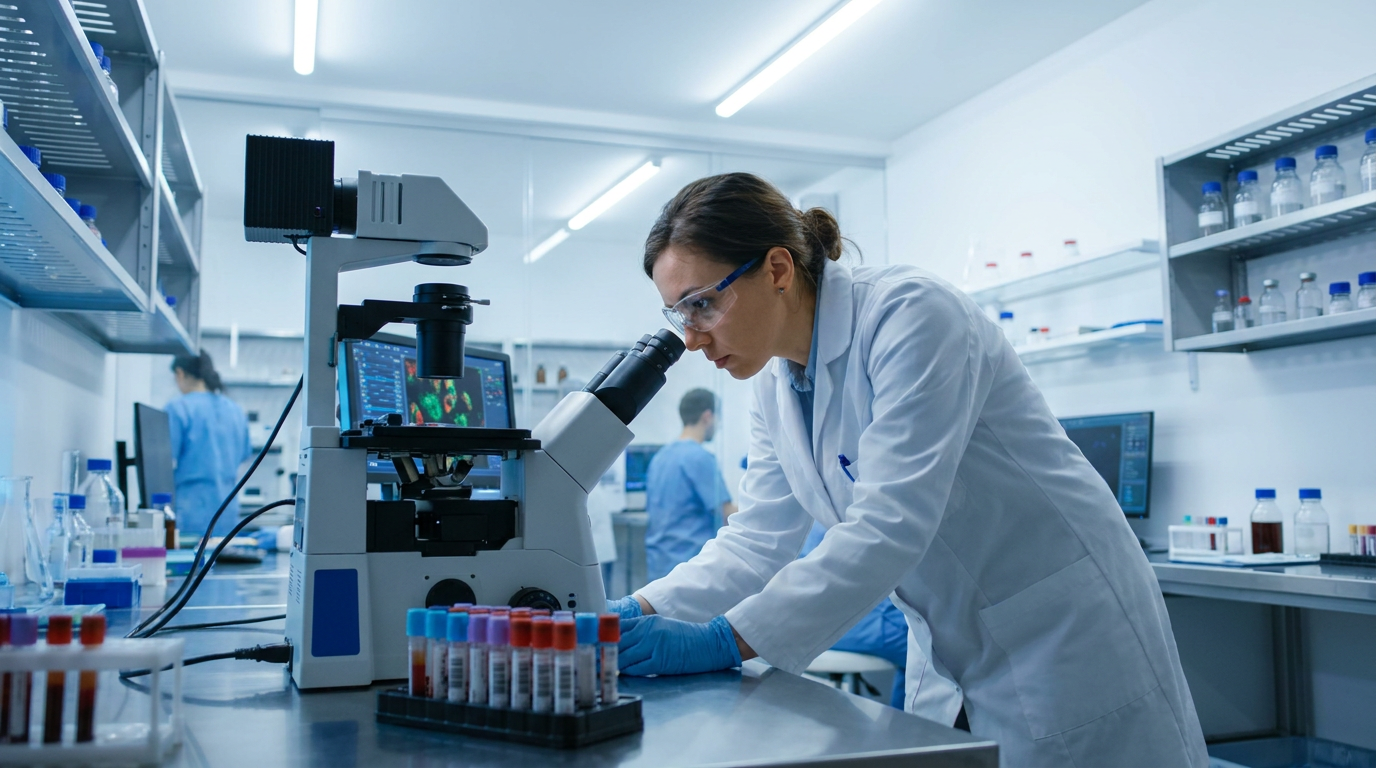
To read those tags, the team used fluorescent markers that attach to specific chemical features. A high-resolution microscope then let them examine millions of nucleosomes. Computer models searched the results for combinations of markers linked to breast cancer. Looking at combinations helped the team find patterns that a single marker would have missed.
For further scientific reporting, GenomeWeb’s coverage of breast cancer nucleosomes, epigenetics and prognosis provides additional context about the research.
What Does the Reported 95% Accuracy Mean?
The headline result is how well the test separated women with breast cancer from healthy women. The researchers first compared blood samples from 77 women with breast cancer against samples from 30 healthy women. The test reached an AUC of 0.95, including in patients with early-stage disease.
AUC is a score for how well a test tells two groups apart. A score of 1.0 is perfect, and 0.5 is no better than a coin toss, so 0.95 is a strong result. But it is not the same as saying the test would correctly diagnose 95 out of every 100 women in a real clinic.
The team also combined samples from different medical centres. In that larger group of 188 samples, the model reached an AUC of 0.96. The test also performed well across different breast density levels. Dense tissue can hide tumours on mammograms, so a blood test could offer another way to spot signs of cancer in those cases.
These results still need to be confirmed in larger studies with more diverse groups of women.
Can the Blood Test Predict Breast Cancer Recurrence?
Detecting cancer is only part of the story. The scientists also asked whether the test could show which patients might see their cancer return after treatment. Recurrence means the cancer comes back, either in the same area or somewhere else in the body.
They found that some patients had higher levels of epigenetic markers tied to aggressive cancer cells, and those markers were linked to a greater risk of recurrence. A second model reached an AUC of 0.81 when separating patients whose cancer returned from those who stayed disease-free during follow-up.
That figure is different from the 0.95 result. The 0.95 relates to finding breast cancer. The 0.81 relates to estimating the risk of recurrence.
One day, blood-based testing like this may help doctors decide who needs closer monitoring after treatment. For now, it cannot say with certainty whether any one patient’s cancer will return.
How Is This Test Different From Mammograms and Biopsies?

A mammogram uses low-dose X-rays to take pictures of breast tissue. It is widely used for screening and can find abnormal areas before symptoms appear.
A blood test makes no pictures. It looks for molecular signals in the blood instead.
A biopsy removes a small piece of breast tissue so specialists can study it under a microscope. According to the National Cancer Institute, a biopsy is the only sure way to diagnose breast cancer.
The experimental blood test could work alongside these methods rather than replace them. You can read more about mammograms and breast cancer screening from the National Cancer Institute.
What Are the Possible Benefits for Patients?
If future studies confirm the findings, the technology could help in a few ways:
- It could give doctors an extra way to spot early signs of breast cancer, especially when imaging results are hard to read.
- It could help researchers understand how different groups of cancer cells behave.
- Its recurrence-related markers could help doctors decide which patients may need closer follow-up.
None of this is available to patients today. But it shows how blood-based methods are being added to the tools used to study and manage breast cancer
What Are the Limitations of the Research?
The results are promising, but there are real limits:
- Small groups. The first diagnostic study involved relatively few patients and healthy volunteers. Larger studies are needed to see how the test performs in the general population.
- Past samples. The researchers studied samples that had already been collected. The method has not been tested in a large screening programme that follows women forward in time.
- Cancer type. The diagnostic work in the paper focused on luminal breast cancer, one of the main types. How well the test works for other types is still to be shown.
- Look-alike signals. It is not yet clear whether the test can reliably tell breast cancer apart from other conditions that may produce similar biological signals.
- Missing measures. Researchers still need to establish sensitivity, specificity, false-positive rates and performance across different ages and populations.
The study was published in a peer-reviewed journal, but that does not mean the test is approved for routine medical use.
What Could This Mean for the Future of Breast Cancer Screening?

Scientists are increasingly studying how blood samples can reveal what is happening inside the body. These approaches are often called liquid biopsies. The EPINUC method adds to this work by reading the epigenetic patterns carried by nucleosomes in the blood.
If later clinical studies confirm its performance, the test could one day support existing screening methods and add information about recurrence risk. It is too early to say when, or whether, it will reach patients.
In the meantime, women should keep following recommended breast cancer screening guidance and talk to a doctor about any unusual changes in the breast. The World Health Organization’s breast cancer information explains why early diagnosis and timely treatment still matter so much.
Conclusion: A Promising Step Towards Earlier Breast Cancer Detection
This experimental blood test points to a possible new way to find breast cancer early and to judge the risk of recurrence. By reading epigenetic changes in circulating nucleosomes, researchers reached an AUC of 0.95 for separating breast cancer samples from healthy ones. A separate model reached 0.81 for predicting recurrence.
More research is needed before the test can be used in everyday healthcare. For now, it is a promising research finding, not a replacement for established screening or diagnosis.